الخميس، 30 ديسمبر 2010

Groupon Halfway in $1 Billion Round of .

Groupon Inc., the daily online coupon service that recently spurned a takeover offer from Google Inc., has raised $500 million of a nearly $1 billion round of new funding, according to a regulatory filing.

Groupon, which offers daily discounts for selected products and services, disclosed in a Securities and Exchange Commission filing that it has secured just more than $500 million of a funding round expected to reach slightly more than $950 million in total. Nearly $350 million from the new funding round will pay for shares held by the closely held company's directors, according to the filing.

None of the investors behind the new funding round was identified. A Groupon spokeswoman declined to comment.

Directors named in the filing who could be cashing out their shares include Andrew Mason, Groupon's founder and chief executive, as well as board members Ted Leonsis and Peter Barris.

According to SharesPost, which provides an exchange for equity in private firms, investors have been seeking to buy shares in Groupon for as much as $125 each.

Earlier this month, Groupon walked away from a takeover offer from Google reportedly valued at as much as $6 billion.

The two-year-old company, which is now widely expected to pursue an initial public offering of shares, operates in 35 countries and employs roughly 1,000 people at its Chicago headquarters.

The company last week hired former Amazon.com Inc. executive Jason Child to be chief financial officer


Read more: http://online.wsj.com/article/SB10001424052748703909904576052071145989058.html#ixzz19dpf4GUC

Groupon Halfway in $1 Billion Round of Funding

Groupon Inc., the daily online coupon service that recently spurned a takeover offer from Google Inc., has raised $500 million of a nearly $1 billion round of new funding, according to a regulatory filing.

Groupon, which offers daily discounts for selected products and services, disclosed in a Securities and Exchange Commission filing that it has secured just more than $500 million of a funding round expected to reach slightly more than $950 million in total. Nearly $350 million from the new funding round will pay for shares held by the closely held company's directors, according to the filing.

None of the investors behind the new funding round was identified. A Groupon spokeswoman declined to comment.

Directors named in the filing who could be cashing out their shares include Andrew Mason, Groupon's founder and chief executive, as well as board members Ted Leonsis and Peter Barris.

According to SharesPost, which provides an exchange for equity in private firms, investors have been seeking to buy shares in Groupon for as much as $125 each.

Earlier this month, Groupon walked away from a takeover offer from Google reportedly valued at as much as $6 billion.

The two-year-old company, which is now widely expected to pursue an initial public offering of shares, operates in 35 countries and employs roughly 1,000 people at its Chicago headquarters.

The company last week hired former Amazon.com Inc. executive Jason Child to be chief financial officer


Read more: http://online.wsj.com/article/SB10001424052748703909904576052071145989058.html#ixzz19dpf4GUC

Here's Why Google Won't Become A Wireless Carrier (GOOG, VZ, T)

CNNMoney's David Goldman speculates today that Google might try to become a wireless carrier to make sure that services like Google Voice and YouTube won't be blocked by carriers like Verizon and AT&T.

There's only one problem, as pointed out by MG Siegler at TechCrunch: the existing wireless companies will scream bloody murder to the U.S. government.

Why wouldn't the government come down on Google's side? Our handy chart from earlier in December explains:

chart of the day, tech companies spending on lobbying, dec 2010


As if that's not enough, the Center for Responsive Politics also notes that the CTIA--the lobbying arm of the wireless industry--spent another $6.6 million lobbying in 2010.

Lest this seem too cynical, there's another reason why Google might not even try to get into the wireless business. The bulk of revenue from Android today comes from Google search. If Google announced plans to get into the wireless business, how long would it take Verizon to call Microsoft and make Bing the default search engine on all Verizon phones and browsers?


Revised Paul Allen lawsuit continues to show what's wrong with tech पतेंट्स

Four months after filing a laughably broad patent lawsuit against a Who's Who of tech companies--and only weeks after a judge tossed out its complaint for being too vague--Paul Allen's Interval Licensing is at it again.

The Seattle corporation, the surviving entity of the defunct Interval Research firm set up by the Microsoft co-founder in the mid 1990s, filed a revised complaint Tuesday against AOL, Apple, eBay, Facebook, Google, Netflix, Office Depot, OfficeMax, Staples, Yahoo and YouTube.

Interval's amended, 35-page filing (PDF) pads out its earlier 15-page complaint by specifying such features as Apple's Dashboard software, the notifications interface in Google's Android operating system and Netflix's viewing suggestions as infringing on Interval patents. It asks for unspecified damages from those companies as well as an injunction on them shipping any products with the allegedly infringing features.

(The four patents in question: "Browser for use in navigating a body of information, with particular application to browsing information represented by audiovisual data" [patent no. 6,263,507]; "Attention manager for occupying the peripheral attention of a person in the vicinity of a display device" [no. 6,034,652]; "Attention manager for occupying the peripheral attention of a person in the vicinity of a display device" [no. 6,788,314]; and "Alerting users to items of current interest" [6,757,682].)

As before, the features Interval claims continue to be insultingly generic. For instance, an allegation that AOL and Gmail's spam-filtering software infringes on an Interval patent because it is "based at least in part on a comparison between the new email and other emails that have been received." (Sure: Like nobody ever thought to make such a statistical comparison until Interval came along.) Later, it contends that when Netflix "generates a display of related content items" after "a user views a particular content item," that infringes on an Interval patent too. (Right, because the concept of a store or a catalog suggesting a related item to a shopper didn't exist until Interval scientists had a brainstorming session.)

And as before, Interval's suit doesn't target Microsoft or Amazon (which happens to pay rent to Allen's Vulcan Real Estate), even though both companies' products would seem to infringe on the same patents.

Bear in mind, I am not a lawyer. But I know a thing or two about the history of computing and the Internet. So I feel within my competency to suggest that Interval's patents are junk. They describe general concepts that should have been obvious to anybody of ordinary skill in this field in the mid 1990s--and for which it shouldn't be difficult to find "prior art" showing that other people had thought of the same thing years before. Had the U.S. Patent and Trademark Office provided the "high quality" examination of patent applications it promises, it's hard to see how these patents would have been granted in the first place.

But that Alexandria-based agency did grant them. So unless and until these patents get invalidated--which can take an absurdly long time--Interval can advance a legally plausible claim to have a property right on dynamically-updated Web sites and multitasking user interfaces. That covers most of the software platforms you use today. PaidContent.org's Joe Mullin phrased things well in a commentary yesterday (emphasis in the original):

If patent claims on such basic ideas are found to be valid, there are surely hundreds of other potential defendants that could be sued by Interval Licensing. Paul Allen would be essentially a tax collector for the internet.

That might be okay if you think that patents are an inalienable right that inventors deserve. But they're not. Patents, copyrights and other intellectual-property rights exist only to benefit society at large. That--not a notion that inventors or authors have a special right to make money off their work--constitutes the sole reason for their existence in this country.

What gives me a reason to spout such a radical notion? The United States Constitution, which in Section 8 of Article I grants Congress the authority to "promote the progress of science and useful arts." How so? By "securing for limited times to authors and inventors the exclusive right to their respective writings and discoveries." The former justifies the latter--not the other way around.

Would anybody now like to explain how a patent system that allows a company to claim it's invented an entire category of software and then drag a seemingly random selection of competing firms into expensive, time-consuming litigation promotes the progress of anything but the patent-law bar

Yext Heats Up Battle Against Google For Local Ad Dollars

Our Channel ReadWriteBiz, sponsored by Yola.com, is a resource and guide for small businesses. Yola.com is an award winning website builder that makes it easy for small businesses to create a website. With Yola's professional templates and easy-to-use tools, you can make a website that helps you stand out from the competition.

yext-tags.jpgRemember when Google launched Tags, a local advertising up-sell aimed at local small businesses? Companies like Yelp and YellowPages certainly do, and they've joined a few other local directory sites in launching a competing product by the same name.

Techcrunch reports that about a dozen sites, all feeling the heat from Google's potentially disruptive move into local advertising, have teamed up with a startup called Yext to mount a defensive challenge against the search Titan with their own version of Tags.

On Monday, [Yext] will launch a new feature called "Tags" which will let small businesses highlight their names with a little tag and customizable message across about a dozen local listings sites. Launch partners for this "Tag Alliance" (I like my name better) will include MapQuest, Citysearch, Yellowbook, Local.com, SuperPages, White Pages, MerchantCircle, and Topix, with more to come.

In both incarnations, Tags is essentially a way for a business to mark their listings with a small, colored graphic so that it stands out in a larger directory or in search results. The tags can be appended with additional information, including promotions or mobile coupons.


One of the primary purposes of Google's Chrome browser is to push what Google does best: search. The address bar has been integrated with the search box--all queries, suggestions, and misspelled URLs go through Google first.

But Chrome is only the latest service to use Google as a middleman. The company has become so synonymous with web browsing that most users see its search box as a replacement for the address bar. Topping the charts for the most searched terms of 2010, according to a new report from Experian Hitwise, are searches that could have been found simply by adding ".com."

YouTube, Craigslist, and MySpace are some of the top ten most searched items; in the top 50 are Netflix, ESPN, and Hulu. Instead of heading directly to YouTube.com or Netflix.com, millions of users every month prefer to search for the sites on Google and click the top result, rather than typing a measly four extra characters.

Nothing demonstrates this (laziness? addiction?) more than searches for Facebook. The term "Facebook" was the top-searched term for 2010 (not to mention 2009), and accounted for 2.11% of all US searches. What's more, four variations on the term "Facebook" were among the top 10 searches--including "Facebook.com" and "www.Facebook.com".

Together the Facebook queries make up nearly 3.5% of overall Google searches, a 207% increase since last year. A recent report pegged monthly Google search queries at 10.6 billion, meaning Facebook-related searches--those users specifically looking to go to Facebook.com--make up around 370 million monthly searches in the US, and close to 4.5 billion searches annually.

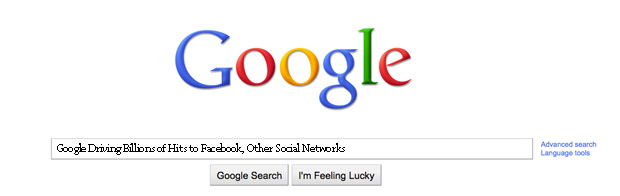
For a company trying to make headway into social networking, Google drives a significant amount of traffic to other social networks. A whopping 4.18% of all Google searches are social network-related terms--billions of hits that, we can safely assume, are not heading to Google Buzz. And it's not likely the search giant is earning revenue from this traffic either; Google charges for advertising, not actual results. They are, however, paying for the servers that crunch these searches.

This represent a huge chunk of traffic that could easily disappear when more people figure out how to use their browser's address bar--or start using the increasingly popular mobile apps that take them directly to a site or service.

Apps We Use: Google Sky Map [Android]

Platforms: Android

Cost: Free

Developer: Google

Rating: 4/5

No apologies for featuring another Google app — and you don’t have to be a star gazer to find this app utterly compelling.

Google Sky Map is a great augmented reality app that overlays a map of the night sky on wherever you are facing, showing you what stars, planets, constellations and other celestial objects in that area of the sky, or what you would see if it is daylight.

You can also search for celestial objects, so if you want to know where Saturn is, or perhaps the Crab Nebula, then type it in and the phone will direct you to its location in the sky.

Perhaps of rather less use, but fun nevertheless, is the time travel function. Should you wish to, you can see what the stars looked like in say the Apollo Moon landings. Not quite sure why you would want that, but if you do, well there it is for you.

For rank amateur astronomers like me, it would be nice if there was more information about the objects you are looking at—perhaps linking popular objects to Wikipedia or an other source so you can make more sense of the sky.

A couple of feature requests might enhance the app. It would also be quite cool to see what satellites are passing by when you gaze up. And what about injecting the overlay into the camera’s image, so you can annotate what you are actually looking at.

While not perhaps the most useful app, it is curiously compelling and certainly helps you make sense of the world and our place in